EVG VIN Check UAE: Complete Guide for Used Car Buyers
You know that feeling when you find a used car that just looks right? Clean exterior, reasonable price, seller seems like a genuine guy. You’re already picturing yourself driving it home.
Hold that thought.
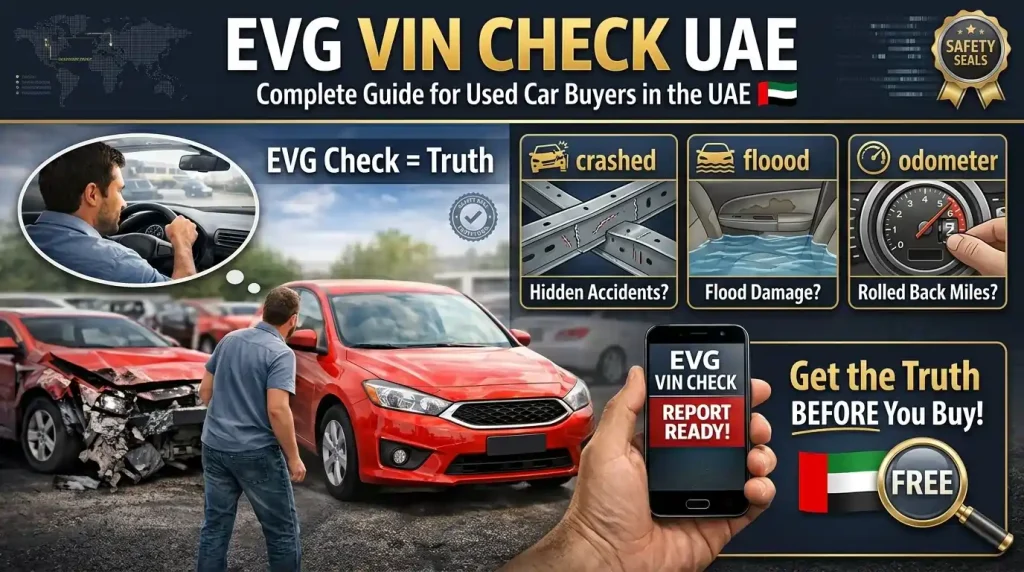
Because here’s what doesn’t show up in the photos: accident damage. Flood history from the 2024 rains. Mileage that’s been rolled back. These problems don’t announce themselves; they just become yours the moment you hand over the cash.
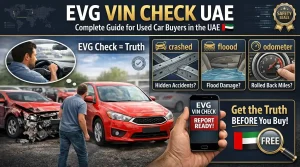
The EVG VIN check changes that. It’s a free government tool that reveals a car’s accident history in minutes. This guide shows you exactly how to use it, what it misses, and what to do next. No fluff. Just what works. Let’s dive in.
What is a VIN/Chassis Number?
Let’s start with the basics. A VIN, or Vehicle Identification Number, is exactly what it sounds like: a 17-character code that identifies every car on the road. Think of it as the car’s fingerprint. No two vehicles share the same one.
In the UAE, most people still call it the “chassis number.” Same thing, different name.
Where do you find it?
Usually in three places:
- On the Mulkiya (registration card), the easiest place to start
- Stamped on the dashboard, driver’s side, look through the windshield from outside
- On a metal plate inside the driver’s door frame, open the door and check
Pro tip: check all three spots. If the numbers don’t match, walk away. Seriously.
What do the 17 digits mean? You don’t need to memorize this, but knowing the basics helps:
| Digits | What They Tell You |
| 1–3 | Manufacturer and country (W = Germany, J = Japan) |
| 4–8 | Vehicle specification: model, engine, body type |
| 9 | Security check digit (validates the VIN) |
| 10 | Model year |
| 11–17 | Unique serial number for that specific car |
Quick country code cheat sheet:
- J – Japan (Toyota, Nissan, Honda)
- W – Germany (BMW, Mercedes, Audi)
- 1, 4, 5 USA
- L – China
- M – India
- K – Korea
Why does this matter? Let’s say you’re looking at a “Japanese specification” Land Cruiser, but the VIN starts with 1. That means it’s actually an American import. Nothing wrong with that, but at least you know. The VIN tells the truth. You just have to read it.
What is EVG VIN Check?
Now that you understand the VIN itself, let’s talk about where to check it. EVG stands for Emirates Vehicle Gate. It’s the UAE government’s official online platform for vehicle-related services. Think of it as the one place where traffic authorities across multiple emirates share information.
The best part? It’s completely free.
What does the EVG VIN check show you? Mainly one thing: accident history. If a car has been in a crash that was reported to police anywhere in the UAE, EVG will likely have a record of it. You’ll see:
- Whether an accident happened
- When and where it occurred
- The official report number
That’s it. No ownership history, no service records, no mileage verification. But for a free tool, that’s still pretty valuable.
Here’s the catch: emirate coverage
EVG works great for:
Abu Dhabi
Sharjah
Ajman
Umm Al Quwain
Ras Al Khaimah
Fujairah
But Dubai? That’s where things get messy.
EVG has limited or incomplete data for Dubai-registered vehicles. Why? Dubai runs its own separate systems. So if you’re checking a car with a Dubai plate, EVG might show nothing even if the car was in a major crash.
Does that mean you skip the check? No. It just means you need to do more than EVG for Dubai cars. We’ll cover exactly what to use instead in a moment. Think of EVG as your first step, not your last. It’s free, it’s fast, and it catches plenty of issues. But for complete peace of mind, especially with Dubai cars, you’ll want to dig deeper.
What EVG VIN Check Shows You
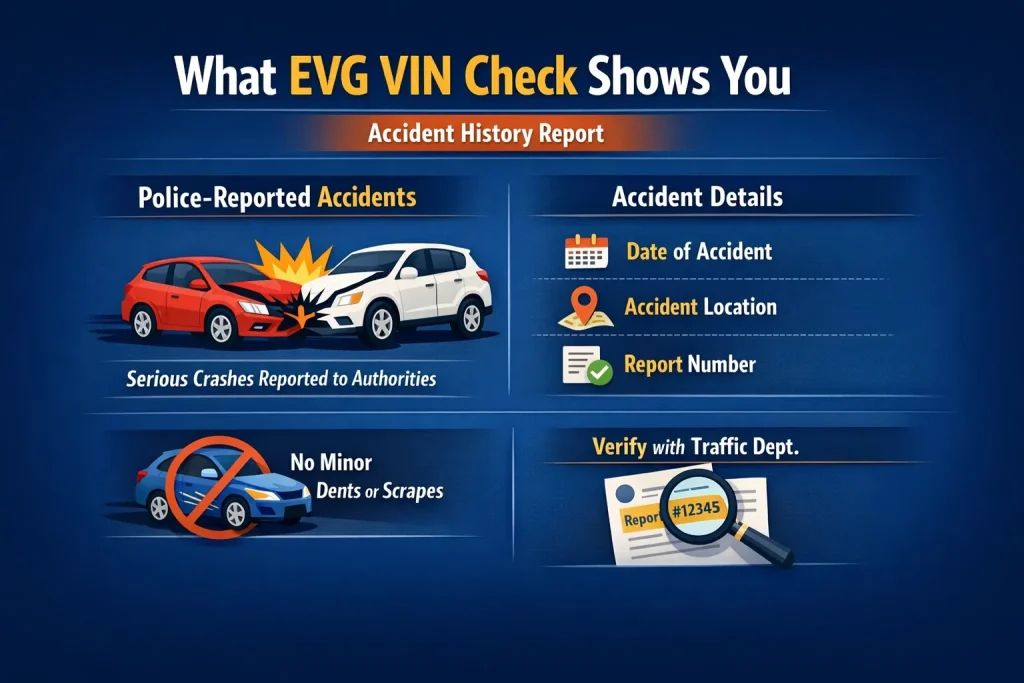
So what exactly pops up when you run that 17-digit VIN through EVG? Let’s break it down.
1. Police-Reported Accident History
This is the main event. If the car has been in any accident that was officially reported to the UAE authorities, EVG will usually have it on record. We’re talking about crashes serious enough that someone involved actually called the police.
What you won’t see? Minor parking lot scrapes that got settled privately. Small bumps that never made it to an official report. Those don’t show up anywhere.
2. The Details Matter
When an accident does appear, EVG gives you
- Date: exactly when it happened
- Location: which emirate and area
- Report number so you can verify it’s real
That report number is useful. If something feels off, you can follow up with the relevant traffic department.
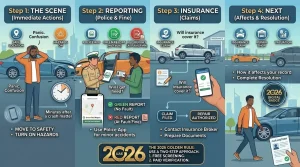
Found an accident in history? Our EVG accident reporting fines insurance claims guide tells you what to do after an accident, explains reporting, fines, and insurance claims.
3. Vehicle Verification
This one’s simple but important. EVG confirms whether the vehicle actually exists in government records. You’d be surprised how many people skip this step and later discover they’re buying a car that was never properly registered.
The system also shows basic identification details, make, model, and year to confirm the VIN matches the car you’re looking at.
A quick reality check
Here’s what EVG won’t tell you:
- How many owners does the car have?
- If the mileage was rolled back
- Whether it has a service history
- If it were flood-damaged (unless reported as an accident.
- Before buying a used car, check for unpaid fines. They can become your responsibility after purchase.
Think of EVG as a solid starting point. It catches many red flags, but it doesn’t catch everything.
The key is knowing what you’re looking at. A clean EVG report doesn’t guarantee a perfect car. But a report showing a major accident? That’s your warning sign to dig deeper or just walk away.
What EVG Does NOT Show (Critical!)
Alright, let’s talk about the stuff EVG keeps hidden. Because honestly? This is where most buyers get caught out. They run a check, see nothing, and assume the car is clean. Big mistake.
1. Dubai Vehicles
Remember how I mentioned EVG has limited data for Dubai? Here’s what that means in practice: you could run a VIN check on a Dubai-registered car that was in a horrific accident last month, and EVG might show absolutely nothing. Blank screen. Clean record. Looks perfect. But the car isn’t perfect. The system just doesn’t see it.
If you’re buying a car in Dubai, EVG isn’t enough. Full stop. You’ll need one of the Dubai-specific tools we’ll cover in a bit.
2. Ownership History
How many people owned this car before you? Was it a family car for ten years or passed between five different owners in two years? EVG won’t tell you. That matters because multiple owners in a short time can be a red flag. Sometimes it means the car had problems nobody wanted to fix.
3. Mileage Verification
This is a big one. Odometer rollback is still a thing in the used car market. Unscrupulous sellers turn back the numbers to make the car look less used than it really is. EVG? Completely blind to it. The system has no idea if that “low mileage” claim is true or not.
4. Service Records
Was the car maintained properly? Oil changes on time? Major services done?
EVG won’t show any of this. You’re flying blind on how well the previous owner treated the vehicle.
5. Flood Damage (Unless Reported)
Here’s something that matters more than ever after the 2024 rains. If a car was flooded but never officially reported as an accident, EVG won’t know about it. The system only catches flood damage if someone filed a police report at the time.
That means thousands of flood-damaged cars cleaned up and resold? They’ll show up clean on EVG. The bottom line is that EVG is useful but limited. Think of it as a basic background check, not the full investigation. For the complete picture, you need other tools. And that’s exactly what we’re covering next.
Step-by-Step: How to Check VIN on EVG
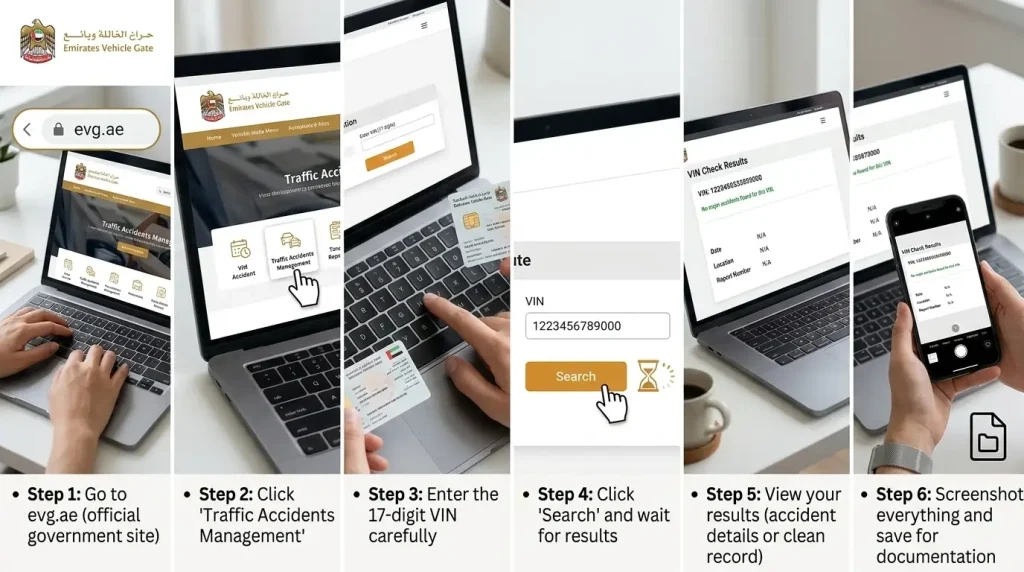
Running a VIN check on EVG takes about two minutes. Maybe less if you’re fast with a keyboard.
Here’s exactly how to do it:
Step 1: Go to evg.ae
Not a third-party site pretending to be official. The real one. Look for the government domain.
Step 2: Click “Traffic Accidents Management.”
You’ll see this option on the homepage. It’s usually easy to spot. If you’re unsure, look for anything related to vehicle history or accident checks.
Step 3: Enter the 17-digit VIN
Type carefully. One wrong letter and you’re checking the wrong car. Double-check it. Then check again.
Step 4: Click search and wait
Give it a few seconds. The system pulls data from multiple emirates, so it’s not always instant.
Step 5: View your results
Either you’ll see accident details, date, location, report number, or you’ll get a message saying no accidents were found. Both are useful pieces of information.
Step 6: Screenshot everything
Take a photo of the results. Save it. This is your proof. If the system shows an error or the VIN doesn’t work, contact EVG support for help. They can check if your traffic file is linked correctly.
If the seller later claims they didn’t know about an accident, you have documentation. If the car is clean, you have peace of mind. Now here’s the pro tip that saves people
Do the check in front of the seller.
Seriously. Pull out your phone right there. Open the site. Type in the VIN while they watch.
Watch their face while the results load.
An honest seller? They’ll wait patiently. Maybe even thank you for being thorough. A seller hiding something? You’ll see it. A slight shift in posture. A nervous glance. A sudden need to check something in the car. Sometimes the reaction tells you more than the report itself.
And if they refuse? If they make excuses about why you can’t check right now?
Walk away. No car is worth that risk.
The Dubai Problem: Alternative Checks
Let’s address the elephant in the room. If you’re buying a car with a Dubai plate, EVG is basically useless. The system just doesn’t have good data from Dubai. You could check a written-off car and get nothing back.
So what do you use instead?
Option 1: RTA Dubai (120 AED); The Gold Standard
This is the one most people don’t know about but should. RTA offers something called a Technical Vehicle Status Certificate. Fancy name, simple purpose: it gives you the complete history of any Dubai-registered vehicle.
For 120 dirhams, you get:
- Accident history (officially reported)
- Ownership records (how many owners)
- Insurance status
- Outstanding fines
- Registration history
Is it free? No. Is it worth every fils? Absolutely. Think of it this way: 120 AED now could save you from buying a 40,000 AED headache later. Worth it.
Option 2: Dubai Police (Free); The Quick Check
If you’re not ready to spend money yet, start here. Call 901, the Dubai Police non-emergency number. Have the VIN ready. They can do a quick accident history check for free.
The catch? It’s basic. They’ll tell you if there’s a major accident on record, but you won’t get the detailed report like with RTA. Still, it’s free and takes five minutes. No reason not to do it.
Option 3: Tasjeel (~475 AED); The Full Monty
This one’s for when you’re serious about a car. Tasjeel service centers offer comprehensive vehicle inspections. For around 475 AED, they’ll put the car on a lift and check everything:
- Accident history
- Mileage verification
- Outstanding fines
- Ownership details
- Mechanical condition
- Structural integrity
It’s expensive. But if you’re buying a high-value car, say a Land Cruiser or a luxury vehicle, it’s money well spent.
Our honest advice?
Start with Dubai Police (free). If the car passes that sniff test, spend the 120 AED on RTA. And if it’s an expensive or older vehicle, book a Tasjeel inspection. Three layers of checking. Three chances to catch a problem.
Because here’s the thing about Dubai’s used car market: there are amazing cars out there. But the bad ones are very, very good at hiding.
Free vs. Paid VIN Check Tools: Which One Should You Actually Use?
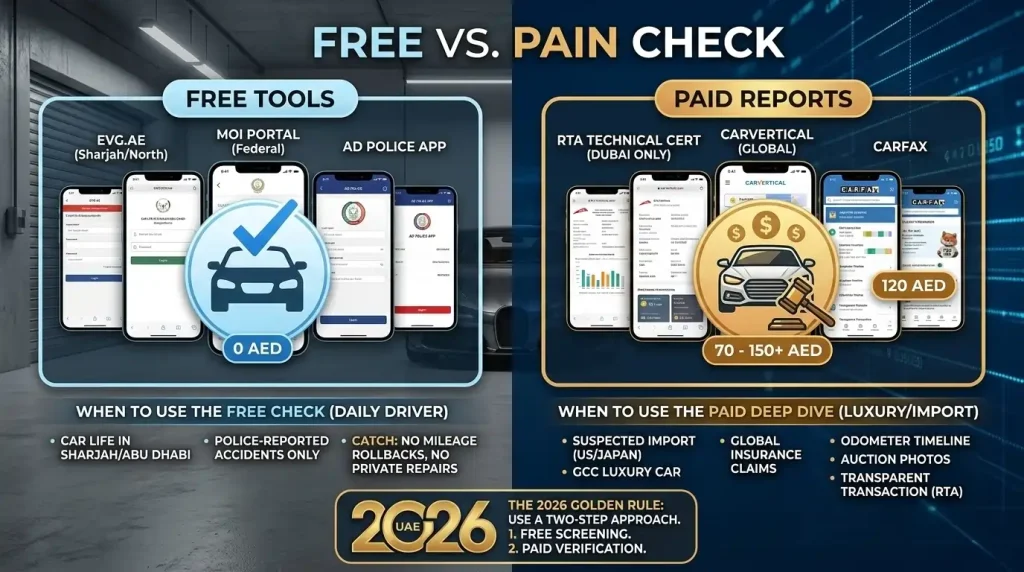
Alright, let’s lay out all your options so you can see them side by side. Because honestly? The right tool depends on where the car is from, how much you want to spend, and how detailed you need to get.
Here’s the complete breakdown:
| Tool | Cost | Best For | The Honest Truth |
| EVG | Free | Northern Emirates & Abu Dhabi | Always start here. It’s free and catches obvious issues. |
| MOI (Ministry of Interior) | Free | All emirates (spotty for Dubai) | Good second check. Sometimes shows things EVG misses. |
| Abu Dhabi Police | Free | Abu Dhabi cars | Fast and reliable if the car is AD-registered. |
| Dubai Police | Free | Quick Dubai checks | Call 901. Takes five minutes. Basic but useful. |
| RTA Dubai | 120 AED | Comprehensive Dubai history | Worth every dirham. The best 120 AED you’ll spend. |
| Tasjeel | ~475 AED | Full official inspection | Expensive but thorough. For when you’re serious. |
| CarFax | ~120 AED | US imports | Essential for American cars. Shows auction history. |
| Car Report | ~99 AED | UAE + imports | Good mid-range option. Decent coverage. |
So which one should you pick?
Here’s my personal workflow after years of doing this:
Step 1: Start free
Run EVG first. If it’s an Abu Dhabi or Northern Emirates car, this might be enough for the basics. If it’s Dubai, don’t stop here.
Step 2: Check with local police
Abu Dhabi cars? Use the Abu Dhabi Police app. Dubai cars? Call 901. Free peace of mind.
Step 3: If it’s Dubai, pay for RTA
This is non-negotiable for me now. 120 AED gives you the real story. I’ve caught three nightmare cars this way.
Step 4: If it’s imported, pay for CarFax
American imports need CarFax. Japanese imports? CarReport or ask for auction sheets.
Step 5: If you’re still unsure, book Tasjeel. For expensive cars or when something feels slightly off, pay the 475 AED. Sleep better at night.
A quick word about “free.”
Free tools are great. Use them. But remember: free only tells you what the government wants you to know. Paid tools often tell you what the seller hopes you never find.
Spend a little now. Save a lot later.
Flood Damage Warning: The 2024 Rains Changed Everything
Let’s talk about something that’s going to affect the used car market for years.
April 2024. The heaviest rainfall the UAE had seen in decades. Streets turned into rivers. Parking lots became lakes. And thousands of cars sat in water for hours.
Some were written off by insurance. Others were dried out, cleaned up, and quietly returned to the market.
Here’s the problem those cars create:
Flood damage isn’t always obvious. A car can look perfect on the outside, but have electrical gremlins hiding underneath. Months later, systems start failing. The infotainment screen glitches. The windows stop working. The engine starts behaving strangely. And EVG?
It won’t show any of this. Unless the owner filed a police report at the time, flood damage doesn’t appear on a standard VIN check. So how do you spot a flood car?
You have to look beyond the screen. Here’s what to check:
1. Follow your nose
Walk inside the car and take a deep breath. Do you smell mildew? Dampness? Something musty? Now smell again. Do you smell heavy perfume or industrial cleaner? Both are red flags. One means water damage wasn’t fully dried. The other means someone’s trying to hide it.
2. Get low and look
Crouch down and look under the seats. Check the metal rails and brackets. Surface rust is normal. Thick rust or water stains? Not normal. Pull back the carpet if you can. Feel underneath. Is it damp? Crusty?
3. Check the spare tire well
Open the trunk. Lift the carpet. Pull out the spare tire. Look inside that well. Mud. Water stains. Rust. Sand in places sand shouldn’t be. All signs that this car sat in water.
4. Inspect the electrics
Roll every window up and down. Test the air conditioning at full blast. Try the radio, the lights, and the seat adjusters. Flood damage causes intermittent electrical problems. If something glitches now, it’ll definitely glitch later.
5. Look for water lines
Open the doors and look at the edges. Sometimes you can see a faint line where water sat. Check the engine bay for watermarks on metal components. In short, after the 2024 floods, there are more damaged cars in the market than ever before. Some sellers are honest about it. Many aren’t.
A clean VIN check doesn’t mean a clean car. Your eyes, your nose, and your attention to detail matter just as much.
Red Flags: When to Walk Away
Not every car is worth buying. Some you should run from. Here’s my list of non-negotiables. If you see any of these, just walk. No second thoughts. No “maybe it’s fine.” Just leave.
1. VIN on the car doesn’t match the Mulkiya.
This is the biggest red flag of all. You check the dashboard VIN. You check the Mulkiya. They’re different numbers.
There’s no innocent explanation for this. None. It could mean the car is stolen, cloned, or had its identity swapped after an accident. Whatever the reason, you don’t want to be anywhere near it.
2. Tampered VIN plate
Look closely at the VIN plate on the dashboard. Really look. Scratches around the numbers? Paint that doesn’t match? Rivets that look newer than the rest of the car? Edges that feel sharp or uneven?
Someone has messed with it. And people only mess with VIN plates when they’re hiding something.
3. Seller won’t share VIN before you meet
Your message about the car. Ask for the VIN to run a quick check. And they hesitate. Or make excuses. Also smart to verify the seller’s driving license; if they’re not the registered owner, ask why.
Or say, “Just come see it in person.” Why would they hide the one thing that lets you verify the car’s history? They wouldn’t. Unless history has problems.
4. “No accidents,” but EVG shows a crash
The seller looks you in the eye and says, “Clean car, never been crashed.” You run the VIN check later that night. A major accident two years ago in Abu Dhabi. They lied. About something big. What else are they lying about?
5. Heavy perfume or bleach smell
Step inside and it hits you. Air freshener. Strong. Overpowering. Or worse, that clean-but-sterile smell of bleach. Both are covering something. Mildew. Mold. Flood damage. Cigarette smoke, they don’t want you to notice. A clean car doesn’t need to smell like a chemical factory.
6. Pressure to decide fast
“Someone else is coming to see it tomorrow.” “I need an answer by tonight.” “There’s another buyer offering cash.” Maybe it’s true. Maybe it’s not.
But here’s what I know: genuine sellers let you take your time. Scammers create a sense of urgency so you don’t look too closely. One more thing. Trust your gut. Something feels off? Is the seller too smooth? Is the car too cheap? The story doesn’t add up. Listen to that feeling. It’s usually right.
There are thousands of used cars in the UAE. This one isn’t special. Walk away and find the next one.
Imported Cars: Extra Steps You Can’t Skip
Imported cars are a whole different ball game. American specs. Japanese auctions. European imports. They can be great deals or absolute nightmares. The trick is knowing which one you’re looking at.
US Imports: Always Check CarFax
If the car was originally sold in America, you need CarFax. Why? Because American insurance companies report everything. Accidents. Flood damage. Theft recovery. Salvage titles. Even odometer readings.
For around 120 AED, CarFax gives you the complete life story of that vehicle. Including things that UAE databases will never show.
Here’s the catch: some sellers bring over written-off American cars, repair them cheaply, and sell them here as “clean.” Carfax catches this every time.
Japanese Imports: Harder to Verify
Japanese cars are popular in the UAE for good reason. Reliable. Well-built. Hold their value. But checking their history? Not as straightforward. Japan doesn’t have a single public database like CarFax. Instead, cars are sold through auctions with grading sheets.
If you’re buying a Japanese import:
- Ask for the auction sheet
- Look for the grade (4 or 5 is good, 3 is average, below that is risky)
- Check for auction notations about accidents or repairs
Some local services like CarReport can help here. Worth the 99 AED if you’re serious.
European Imports: Proceed with Caution. Less common in the UAE market, but they exist.
German cars. British imports.
Sometimes great deals, sometimes expensive problems. The challenge? Parts can be harder to find. Service history is harder to verify. And some European imports come to the UAE because they have issues back home.
The one rule for all imports. Don’t trust the local check alone. A car can have a clean EVG report but a salvage title in its home country. The UAE system only knows what happened here. It doesn’t know about the auction in America or the accident in Japan. Always check the source.
Quick checklist for imported cars:
- US car → CarFax report
- Japanese car → Auction sheets + CarReport
- European car → Specialist inspection
Once you’ve verified the VIN and bought the car, don’t forget to renew the registration on time to avoid fines.
- Any import → Compare mileage across records
- Any import → Look for inconsistent service history
Spend a little extra on checks now. It beats discovering later that your “deal” was someone else’s write-off.
Final Thought
Look, here’s the truth. A VIN check takes five minutes. Costs nothing or maybe 120 dirhams if you’re buying a Dubai car. And it’s the difference between driving happily for years or discovering someone else’s problem three months too late.
Start with EVG. If it’s Dubai, spend on RTA. Imported? Check CarFax or those auction sheets. And trust what your gut tells you. That weird smell? That seller who won’t share the VIN? That pressure to decide now? Listen to it.
The right car is out there. Clean history. Honest seller. No drama. Take five minutes to find it.